Published 5 November 2026 · By the VoltPoint Battery Service team
Car battery dead? What to do in Dubai
Quick checks first, then safety steps for underground car parks, highway shoulders and hot open car parks, and when a jump start is or is not safe.
If your car battery is dead, first make sure you are safe, then do a few quick checks to confirm it really is the battery. If it is, a jump start with a booster pack will usually get you moving, unless the battery is damaged or the car keeps failing to start.
This guide goes through the checks, the safety steps for the places where batteries usually fail in Dubai, and when a jump start is the wrong answer.
Quick checks before you call
These take a minute and can save you a call-out.
| What you notice | What it usually means |
|---|---|
| Nothing at all: no lights, no sound | Battery completely flat, or a loose or corroded terminal |
| Rapid clicking when you press start | Battery too weak to turn the engine |
| Dashboard lights come on but dim or flicker when you try to start | Battery weak |
| One loud click, dashboard lights stay bright | More likely the starter motor or a connection |
| Engine turns over normally but does not fire | Not the battery: fuel, ignition or immobiliser |
| “Key not detected” message, but lights work | Key fob battery may be flat |
Also check:
- Gear position. An automatic will only start in P (and on some cars in N).
- Brake pedal. Most push-start cars need the brake pressed firmly.
- Steering lock. On older key cars, turn the wheel gently while turning the key.
- Key fob. If the fob battery is flat, many push-start cars still start if you hold the fob against the start button or place it in a marked spot. Your owner’s manual shows where.
- Security light. A flashing key or lock symbol after you try to start can mean the immobiliser does not recognise the key. A new car battery will not fix that.
If you are on a highway or main road
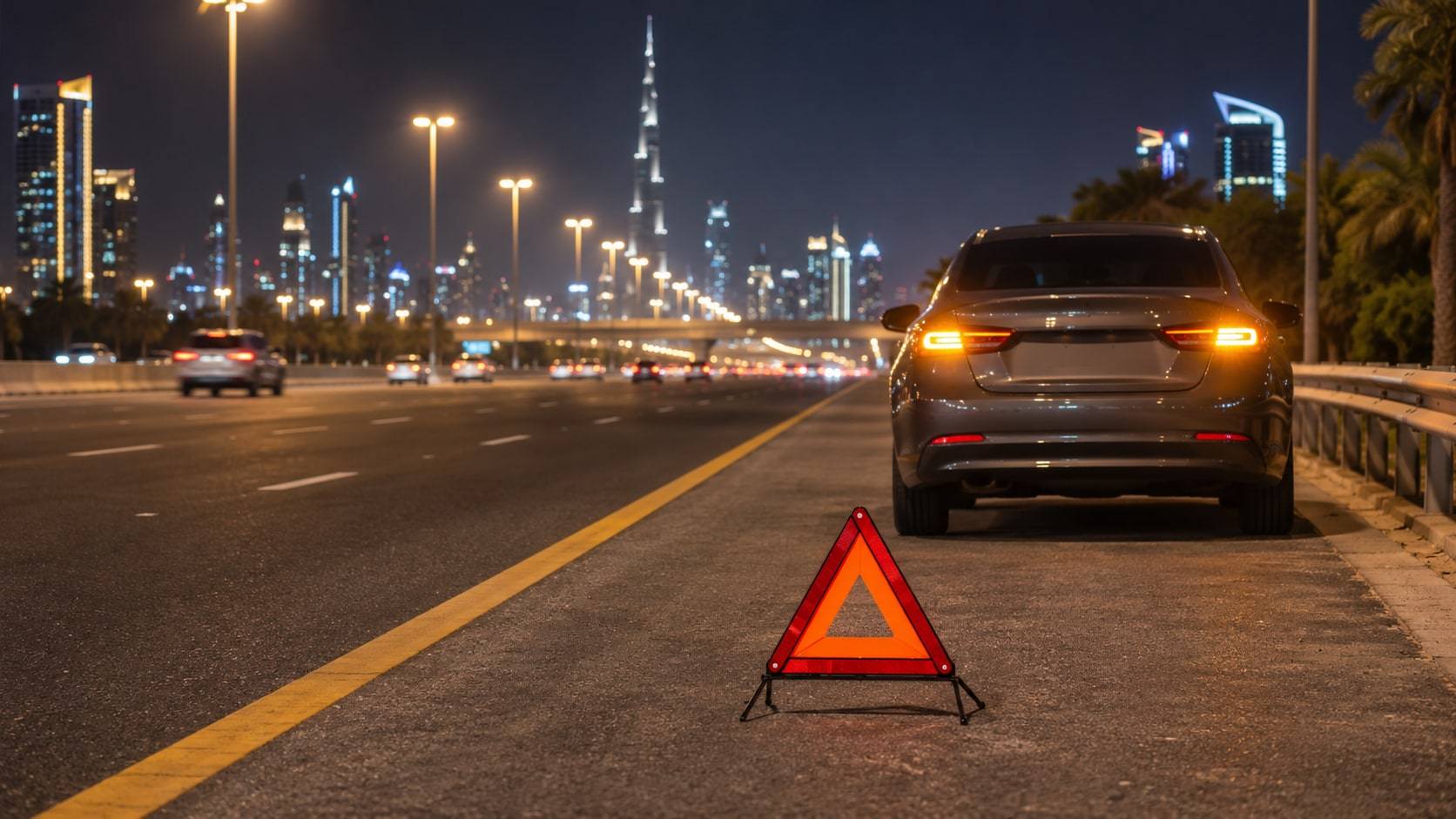
A car that stops on a fast road is the most dangerous case. Your safety comes before the car.
- Turn on your hazard lights straight away.
- Move off the road as far as you can if the car is still rolling, ideally onto the hard shoulder.
- Get out on the side away from traffic and take everyone with you.
- Stand behind the barrier, not between the car and the traffic, and not in front of the car.
- If you are stuck in a live lane and cannot get out safely, keep your seatbelt on, keep the hazards on and call 999.
- Once you are in a safe place, call for roadside help. Tell them the road, the direction of travel and the nearest exit or landmark.
Do not try to jump-start or work on the car on a hard shoulder of a fast road, such as Sheikh Zayed Road. Wait behind the barrier for help.
If you are in an underground car park
Basements and multi-storey car parks are where many batteries fail, often after the car has been parked for a while.
- Note your level and bay number. You will need them when you call.
- Find phone signal. Reception is often weak underground. Walk to the ramp, a lift lobby or ground level to make the call.
- Do not leave the engine running for long in a closed basement once the car is started.
- Tell the helper about height limits. Some car parks have low clearance. A technician with a booster pack can reach cars that another car with jump leads cannot.
- Check car park rules. Some buildings need you to tell security before a technician comes in.
If you are in an open car park in the summer heat
In July and August, a car parked in the sun can become dangerously hot inside within minutes, and the battery is more likely to fail after a hot day.
- Do not wait in a closed car. Wait in a mall, a shop or shaded area.
- Never leave children or pets in the car, not even for a few minutes.
- Drink water and keep your phone charged, because heat drains phones too.
- Give your location clearly: the mall entrance, the parking zone or column number.
- Look at the battery only if it is safe to do so. If it smells of rotten eggs, is swollen, hissing or leaking, do not touch it.
When a jump start is the right answer
A jump start is a good first step when:
- something was left on, such as headlights or a charger,
- the car has been parked for a long time,
- the battery is in good condition and this is the first time it has gone flat.
After a jump start, drive for at least 30 minutes so the alternator can recharge the battery. Then get the battery tested. Our post on jump start or replace explains how to tell a flat battery from a worn-out one.
When not to jump-start
Do not jump-start if:
- the battery is swollen, cracked, leaking or smells of rotten eggs. It is damaged and can release gas or acid.
- you are on the shoulder of a fast road. Wait behind the barrier for help.
- you are not sure where to connect. Many modern cars have the battery in the boot or under a seat, with separate jump-start terminals under the bonnet.
Take extra care with start-stop cars and cars with AGM or EFB batteries, such as many BMW, Mercedes-Benz, Audi and Range Rover models. These cars can be jump-started, but only through the terminals shown in the manual. Connecting to another running car can cause voltage spikes that upset the electronics. A professional booster pack is the safer option. If the car keeps going flat, the battery may also need registering to the car after replacement.
When it is not the battery
Some faults look like a dead battery but are not:
- Starter motor: one click, bright lights, no cranking.
- Immobiliser: a flashing security light, or the engine cranks and stops at once.
- Fuel or ignition: the engine cranks at normal speed but does not start.
- Alternator: the car starts after a jump but dies again while driving, or the battery warning light comes on. See battery or alternator: how to tell.
If the battery tests healthy, replacing it will not fix these faults.
What to tell us when you call
To get help to you quickly, have this ready:
- your exact location: road and nearest exit, or building, level and bay,
- the car’s make, model and year,
- what happens when you try to start it,
- whether the battery looks damaged.
Getting help
We are a mobile service in Dubai. We come to your car with a booster pack, test the battery and the charging system, and replace the battery on the spot if it has failed. We match AGM, EFB or conventional to your car and take the old battery away for recycling. If your car will not start, see our emergency battery replacement or roadside battery assistance pages.
Need help with your battery now?
We come to your car anywhere in our Dubai service area.