Published 5 November 2026 · By the VoltPoint Battery Service team
Battery or alternator? How to tell what is wrong
Dim lights, a battery warning light, clicking, or a car that dies after a jump: which part each symptom points to, and how to check.
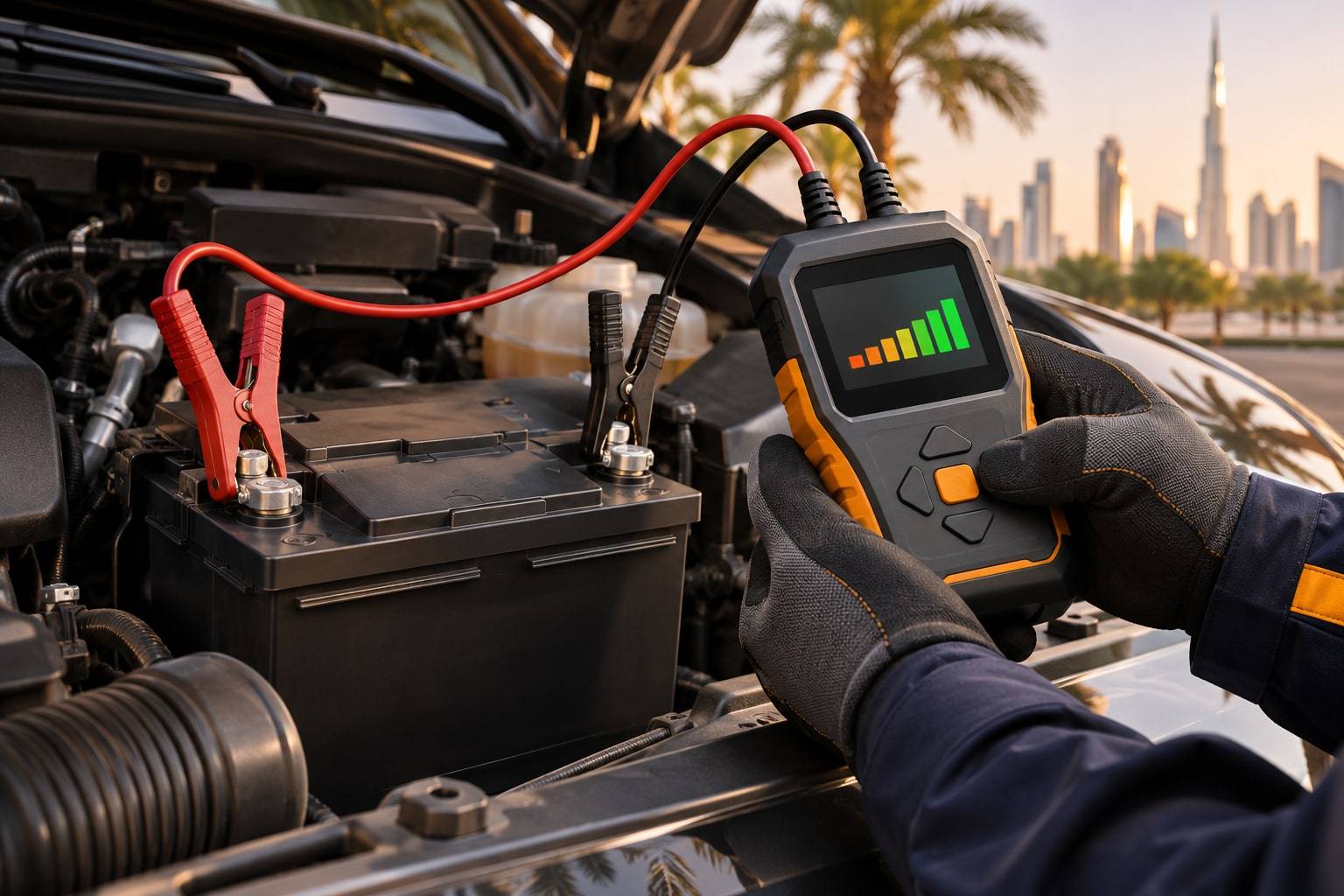
If the car will not start but runs normally after a jump start, the battery is the most likely cause. If the car starts but the lights dim, the battery warning light comes on, or the car dies while you are driving, the alternator is more likely. A voltage check with the engine off and then running usually tells you which one it is.
The battery, the alternator and the starter motor work together, so a fault in one often looks like a fault in another. Here is how to tell them apart.
What each part does
- Battery. Stores power and delivers a large burst of current to start the engine. It also runs the electrics when the engine is off.
- Alternator. Driven by the engine through a belt. Once the engine is running, it powers the car’s electrics and recharges the battery.
- Starter motor. An electric motor that turns the engine over when you press start or turn the key. It draws its power from the battery.
A simple way to remember it: the battery starts the car, the alternator keeps it running, and the starter is the motor that does the turning.
Symptom table
| Symptom | Most likely cause | Also check |
|---|---|---|
| Slow cranking, especially first thing in the morning | Battery | Corroded or loose terminals |
| Rapid clicking, dashboard lights dim or flicker | Flat or weak battery | Terminals and earth cable |
| A single loud click, dashboard lights stay bright | Starter motor or starter solenoid | Battery cable to the starter |
| No sound at all, lights stay bright | Starter, ignition switch, immobiliser or gear selector not in Park | Key fob battery |
| Starts fine after a jump, then will not start again the next day | Battery that no longer holds charge | Parasitic drain, or alternator not charging |
| Starts after a jump, then dies while driving | Alternator | Drive belt, wiring to the alternator |
| Headlights dim while driving, brighten when you rev | Alternator | Drive belt slipping |
| Battery warning light on while driving | Alternator or charging circuit | Belt, battery cables, battery |
| Battery swollen, hot or smells of rotten eggs | Overcharging, often a faulty alternator voltage regulator | The battery itself is damaged |
| Whining or grinding noise from the front of the engine | Alternator bearing or belt | Other belt-driven parts |
| Several random warning messages on the dashboard | Low voltage from a weak battery or poor charging | Both battery and alternator |
Simple voltage checks
You can do a basic check with a digital multimeter set to DC volts. Put the red probe on the positive (+) terminal and the black probe on the negative (−) terminal.
1. Engine off. Measure after the car has been parked for at least a few hours, so you are not reading the surface charge left over from driving.
| Reading, engine off | What it means |
|---|---|
| About 12.6V | Fully charged |
| About 12.4V | Around three-quarters charged |
| About 12.2V | Around half charged. Needs charging. |
| Below 12.0V | Flat or close to flat |
2. Engine running. Start the car and measure again at idle, then with the headlights and AC on.
| Reading, engine running | What it means |
|---|---|
| About 13.7V to 14.7V | The alternator is charging normally |
| Below about 13.2V, or the same as the engine-off reading | The alternator is not charging properly |
| Above about 15V | Overcharging. Usually a faulty voltage regulator. This damages the battery. |
Some modern cars use “smart” charging that lets the voltage drop to around 12.5V–13V at times to save fuel, so a single low reading on these cars is not always a fault. Our car battery voltage chart explains the readings in more detail.
Why voltage alone is not a full test
A battery can show 12.6V and still fail to start the car. Voltage tells you how charged the battery is, not how much current it can deliver. An old or heat-damaged battery may hold a good voltage at rest, then collapse as soon as the starter draws a few hundred amps.
A proper battery test measures cranking ability (CCA) and checks how far the voltage drops while the engine is turning over. An alternator test checks the output under load, not just at idle with nothing switched on. A starter test checks how much current the starter draws and whether the voltage reaches it. Together, they show which part is at fault.
Why replacing the battery does not fix an alternator fault
If the alternator is not charging, a new battery will start the car, but nothing is recharging it. The car runs on the new battery’s stored power until it is flat. That might be an hour of driving or a few days of short trips. Then the car stops again, and you have spent money on a battery that was not the problem.
It can also go the other way. A failing alternator that overcharges can damage a brand-new battery within weeks, and a deeply discharged battery is damaged each time it goes flat. So if the old battery failed early, it is worth testing the charging system before fitting a new one.
A weak battery can also put extra strain on a healthy alternator, because the alternator has to work harder to recharge it. Replacing only the alternator when the battery is the real problem leaves you with the same starting trouble.
When the battery keeps going flat
If the battery tests good and the alternator charges normally, but the car is still flat every few days, the likely cause is a parasitic drain: something that keeps drawing current with the car locked. Common culprits are dashcams on parking mode, GPS trackers, aftermarket alarms and a boot or glovebox light that stays on. Our guide to why a car battery keeps dying covers how to find a drain.
What to do if the warning light comes on while driving
If the battery warning light comes on while you are driving, the alternator has probably stopped charging. Switch off what you do not need, such as the AC, heated seats and the radio, and drive to a safe place to stop. Do not switch the engine off until you are somewhere safe, because it may not restart. If the light comes with a temperature warning or a loss of power steering, the drive belt may have broken, and you should stop as soon as it is safe. Our roadside battery assistance can help if you are stuck.
Getting it tested
We come to your car anywhere in Dubai and test before replacing anything: battery, starter and alternator, with a parasitic drain test if you ask for one. If the battery is the fault, we fit the correct type for your car. If it is not, we tell you so you can take the car to a mechanic for the alternator or starter. Book a battery and charging test.
Need help with your battery now?
We come to your car anywhere in our Dubai service area.